📞 Call Us: 0348 222 4222

Study in Germany
About Germany
- Germany is home to many globally ranked universities known for academic excellence and innovation. German degrees are highly respected worldwide and recognized by employers and institutions across the globe.
- Many public universities in Germany charge no or very low tuition fees, even for international students. This makes Germany one of the most affordable destinations for high-quality education in Europe.
- German universities emphasize hands-on learning, research, and industry collaboration. Students gain practical experience through internships, labs, and real-world projects.
- Degrees from German universities are recognized across Europe and internationally, providing graduates with excellent career opportunities in the global job market.

How it works
How Our Service Works
Seamless Application Process: Your Passport to Success
Apply hassle-free for your dream study abroad program. Say goodbye to paperwork and hello to a smooth journey. Let us guide you every step and make your dreams a reality.
Tailored Study Plans: Carve Your Path to Excellence
Discover your true potential with personalized study plans tailored to your goals. Our experts will guide you on a transformative academic journey. Unleash your unique excellence today.
Expert Guidance: Navigating the Study Abroad Maze
Expert guidance for studying abroad. Choose the perfect program with our experienced team. Trust us on your study abroad journey.
TOP STUDY PERKS
WHY GERMNAY?
World-Class Education
Wide Range of English-Taught Programs
Excellent Career Opportunities
Low or No Tuition Fees
Strong Focus on Research & Practical Learning
Post-Study Opportunities

What is a pathway program?
Pathway programs in Germany provide academic and language preparation for Pakistani students whose HSSC certificates do not directly meet German university entrance standards — specifically for students without 13 years of schooling or a recognised university entrance qualification. These are typically one-year programs offered at private institutions.
- HSSC minimum 50%
- Gap of up to 3 years accepted — gap documents required
- Reference letters required
- IELTS: Overall 5.0 or 5.5 with no component less than 4.5
- PTE: Overall 58–65
- Program cost: €5,000 – €15,000+ at private institutions
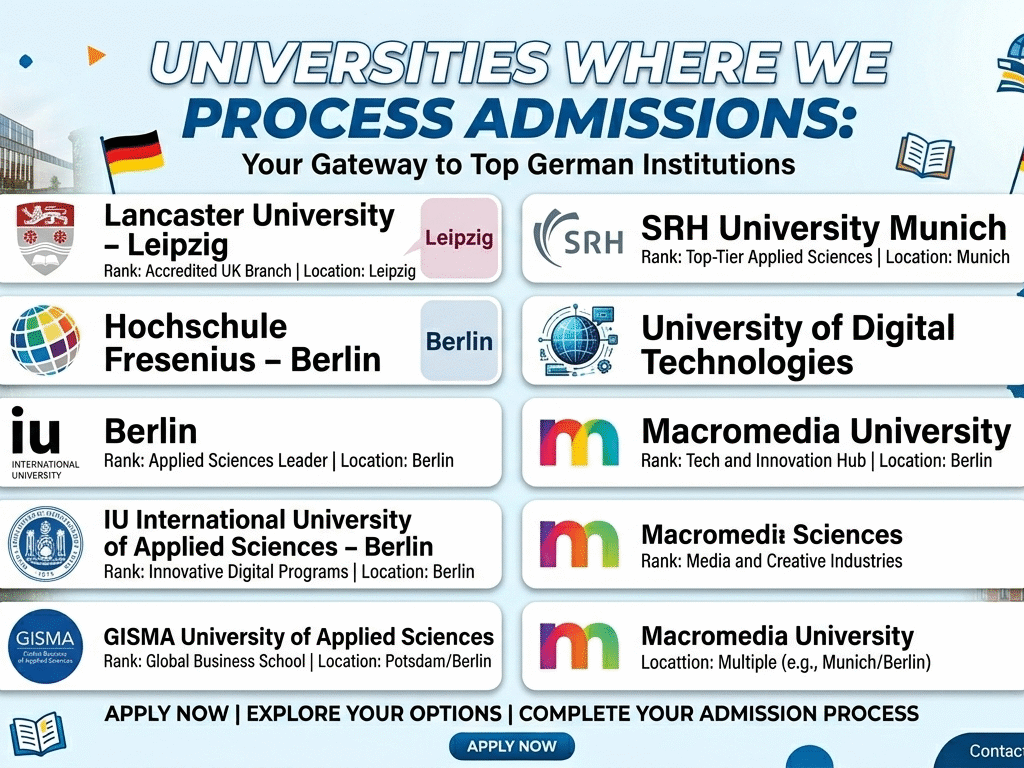
TOP STUDY Institutes
Top Universities in Sweden
Application Process
Sweden University Application Process
Apply for admission with your educational documents and English language test results
Receive your offer letter from the university
Clear the university interview and / or entrance test (if required)
Pay the tuition fee to confirm your place
Receive your visa letter from the university
Set up your blocked account with health insurance — minimum €12,000
Submit your student visa application
Wait for your visa appointment date
Appear on your appointment day with all required documents
Wait for your visa outcome
Admission requirements
Undergraduate degrees
- HSSC with minimum 60%, ideally 70% or higher
- IELTS: Minimum 6.0 bands with no component less than 5.5
- TOEFL iBT: Overall 80–90
- Duolingo: 110 overall and 90 in each section (some programs accept 100 overall and 90 each)
Masters degrees & masters in research
- Minimum GPA 3.0 or high 2nd division with 60–70% in academics
- IELTS: Minimum 6.0 or 6.5 bands with no component less than 5.5
- TOEFL iBT: Overall 80–90
- Duolingo: 110 overall and 90 in each section (some programs accept 100 overall and 90 each)
Tuition fees & expenses
| Fee type | Amount |
|---|---|
| Public university tuitionTuition-free | Semester fee: €250 – €600 only |
| Private university tuition (per year) | €8,000 – €15,000 |
| Living costs (monthly) | €850 – €1,000 |
| Living costs (annually) | ~€10,200 |
| Blocked account (mandatory for visa) | €12,000 / year |
Frequently Asked Questions
What are pathway programs in Germany?
Pathway programs are one-year preparatory courses designed for students whose intermediate qualification (HSSC) does not directly meet German university entry requirements. These programs help students improve academic knowledge and English or German language skills before starting a degree.
What are the requirements for pathway programs in Germany?
Typical requirements include:
- Minimum 50% in HSSC
- Study gap up to 3 years (with supporting documents)
- Reference letters
- IELTS: 5.0–5.5 overall (minimum 4.5 in each band)
- PTE: Around 58–65 overall
What are the requirements for undergraduate degrees in Germany?
For bachelor’s programs, students generally need:
- HSSC with minimum 60% (70% preferred)
- IELTS: Minimum 6.0 overall with at least 5.5 in each component
- Duolingo: 110 overall with 90 in each section (sometimes 100 overall accepted)
- TOEFL: Around 80–90 overall
What are the requirements for master’s degrees in Germany?
For master’s or research master’s programs:
- Bachelor’s degree with GPA 3.0 or 60–70% (high 2nd division)
- IELTS: 6.0–6.5 overall (minimum 5.5 in each band)
- Duolingo: 110 overall with 90 in each section (sometimes 100 accepted)
- TOEFL: Around 80–90 overall
How much does it cost to study in Germany?
Costs depend on the university type:
- Public Universities: Mostly tuition-free, with semester fees of €250–€600
- Private Universities: Around €8,000–€15,000 per year
- Living Expenses: Approximately €850–€1,000 per month
What is a blocked account for Germany?
A blocked account is required for the student visa to prove you can support yourself during your stay in Germany. Students must deposit around €12,000 per year for living expenses.
What intakes are available in Germany?
Germany offers three main intakes:
- Autumn (September/October) – Main intake
- Spring (March/April) – Limited programs in private universities
- Winter (January/February) – Limited programs in private universities